 OneTask
Published
The coffee-to-water ratio, and how to adjust it
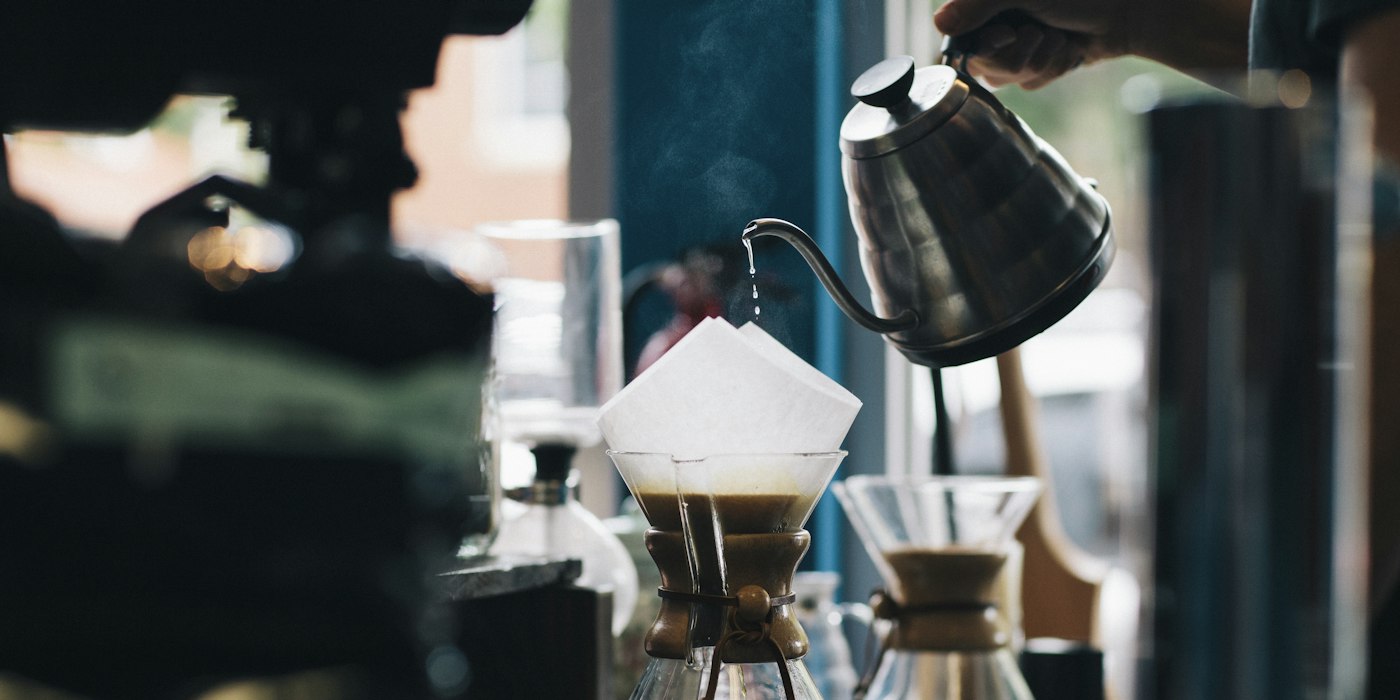
Most coffee recipes come down to one number: the ratio of coffee to water. Get it right and the same beans and the same grinder suddenly taste better. Get it wrong and no amount of fiddling with the grind will fix it. The good news is that the ratio is simple arithmetic, and a kitchen scale is all you need.
What 1:16 means
A brew ratio is grams of coffee to grams of water. 1:16 means one gram of coffee for every 16 grams of water. Since a millilitre of water weighs a gram, you can read it as millilitres too.
coffee (g) = water (mL) ÷ ratio
water (mL) = coffee (g) × ratio
For a 500 mL pour-over at 1:16:
500 ÷ 16 = 31.3 g of coffee
A smaller number after the colon means stronger coffee. 1:14 is stronger than 1:17.
Usual ratios by method
| Method | Typical ratio | Coffee for 250 mL |
|---|---|---|
| Pour-over or drip | 1:16 | 15.6 g |
| French press | 1:15 | 16.7 g |
| AeroPress | 1:14 | 17.9 g |
| Moka pot | 1:10 | 25 g |
| Cold brew concentrate | 1:5 | 50 g |
| Espresso | 1:2 | See below |
These are starting points, not rules. Pour-over and drip sit around 1:15 to 1:17 in most cafés. French press brews a little stronger because the coffee steeps in all the water at once. Moka pots run strong because the basket is simply filled to the brim.
Espresso is different
Espresso ratios are written as coffee in to liquid espresso out, both weighed. An 18 g dose at 1:2 should give about 36 g of espresso in the cup. Because the output is weighed, the crema and the dissolved solids count too, which is why measuring in millilitres does not work well for espresso.
A 1:2 ratio is a normale. Around 1:1 to 1:1.5 is a ristretto, shorter and more intense. Around 1:3 is a lungo.
Cold brew
Cold brew is usually made as a concentrate, around 1:5, steeped for 12 to 24 hours in the fridge or at room temperature. It is then diluted, often 1:1 with water or milk, before drinking. If you brew at a weaker ratio such as 1:8, it can be drunk straight. Coarse grounds matter here; fine grounds turn cold brew muddy and bitter.
Why weigh instead of scoop
A level tablespoon of coffee can weigh anywhere from 5 to 7 grams depending on the roast and grind. Dark roasts are less dense than light ones, so a scoop of dark roast holds less coffee. On a 30 g brew, that difference is enough to change the taste. A cheap kitchen scale that reads to the gram removes the guesswork, and once you know your ratio, it is quicker than counting scoops.
If you must use spoons, weigh a few level spoonfuls once and work out what your spoon holds for your usual coffee.
Fixing the taste
Ratio controls strength: how concentrated the coffee is. Grind and brew time control extraction: how much flavour gets pulled out of the grounds. It helps to change one thing at a time.
| Tastes | Likely cause | Try |
|---|---|---|
| Watery, thin | Too weak | A stronger ratio, such as 1:15 instead of 1:17 |
| Heavy, too intense | Too strong | A weaker ratio, or dilute with a little hot water |
| Sour, sharp | Under-extracted | A finer grind or longer brew |
| Bitter, dry | Over-extracted | A coarser grind or shorter brew |
A coffee can be both weak and bitter, which is why it helps to separate the two. Fix strength with the ratio first, then adjust the grind.
Scaling a recipe
Ratios make scaling easy. A 1:16 recipe for one mug becomes a recipe for a pot by changing the water and dividing again:
1 litre at 1:16 = 1000 ÷ 16 = 62.5 g of coffee
Bigger batches in a pour-over or French press may need a slightly coarser grind, because more coffee takes longer for water to pass through.
Work it out
The coffee ratio calculator gives grams of coffee for any amount of water, or water for a given dose, with standard ratios for pour-over, French press, AeroPress, moka pot, cold brew and espresso, or one of your own. If a recipe gives coffee or sugar in cups or spoons, the cups to grams converter turns them into weights. More handy tools for around the house are in the everyday calculators section.