 OneTask
Published
How much concrete a slab needs, and how many bags that is
A garden shed base, a path, a pad for a water tank or an air-conditioner: small slabs are one of the most common DIY concrete jobs. Ordering the right amount is the part people get wrong. Too little and you are mixing an extra batch while the first one starts to set. Too much and you are paying for concrete you have to get rid of.
The volume formula
A slab is a box, so its volume is length × width × thickness. The only trick is keeping the units the same.
volume (m³) = length (m) × width (m) × thickness (m)
Thickness is usually given in millimetres, so divide by 1000 first. A 3 m × 2.4 m shed base at 100 mm thick:
3 × 2.4 × 0.1 = 0.72 m³
In imperial, work in feet and divide by 27 to get cubic yards, because a cubic yard is 3 × 3 × 3 feet. Thickness in inches has to be divided by 12 first. A 10 ft × 8 ft slab at 4 inches:
10 × 8 × (4 ÷ 12) = 26.7 ft³
26.7 ÷ 27 = 0.99 yd³
Thickness matters more than you think
Thickness is the dimension people guess at, and it has the biggest effect on the order. Going from 75 mm to 100 mm adds a third more concrete. Going to 150 mm doubles it.
| Use | Typical thickness |
|---|---|
| Garden path, light shed base | 75–100 mm (3–4 in) |
| Patio, larger shed, garden room | 100 mm (4 in) |
| Driveway for cars | 100–150 mm (4–6 in) |
| Garage floor, heavier loads | 125–150 mm (5–6 in) |
These are general guides. For anything structural or anything a building permit covers, the engineer's drawings or the local code set the thickness, not a table.
Ground is never perfectly flat either. If the excavation is 20 mm deeper in places, the slab is 20 mm thicker there, and the concrete goes in regardless. Measure the depth at several points after the base is compacted and use the average.
Add a margin for waste
Concrete gets spilled, stuck to the mixer and the barrow, and pushed into low spots in the sub-base. Formwork bows a little under the weight. A margin of 5–10% is normal:
| Slab volume | +5% | +10% |
|---|---|---|
| 0.5 m³ | 0.53 | 0.55 |
| 1.0 m³ | 1.05 | 1.10 |
| 2.0 m³ | 2.10 | 2.20 |
Use the higher end for uneven ground, hand mixing or a first job. Running short in the middle of a pour leaves a cold joint, a weak line where fresh concrete meets concrete that has already started to go off.
From volume to bags
Bagged premix is sold by weight, so the volume has to become a weight first. Concrete weighs roughly 2400 kg per cubic metre once mixed with water, and a bag of dry premix makes a little less volume than its weight might suggest.
A practical rule: a 20 kg bag makes about 0.009–0.01 m³ of concrete, so it takes around 100–110 bags per cubic metre. In US sizes, an 80 lb bag yields about 0.6 cubic feet, so about 45 bags per cubic yard.
| Slab | Volume +10% | 20 kg bags | 80 lb bags |
|---|---|---|---|
| 2 × 2 m × 75 mm | 0.33 m³ | ~35 | ~19 |
| 3 × 2.4 m × 100 mm | 0.79 m³ | ~85 | ~46 |
| 4 × 3 m × 100 mm | 1.32 m³ | ~140 | ~76 |
The yield printed on the bag is the number to trust; it varies between brands.
When to stop using bags
Bag counts climb quickly. Somewhere past half a cubic metre, mixing by hand or with a small mixer becomes a long, hard day, and getting a consistent pour across the whole slab gets difficult. Beyond about a cubic metre, a ready-mix truck or a mini-mix delivery is usually cheaper once your time is counted, and the concrete is more consistent.
Ready-mix suppliers sell by the cubic metre or yard, often in increments of a tenth or a quarter, with a minimum load. Give them your volume including the margin and ask them to round up.
Mesh and reinforcement
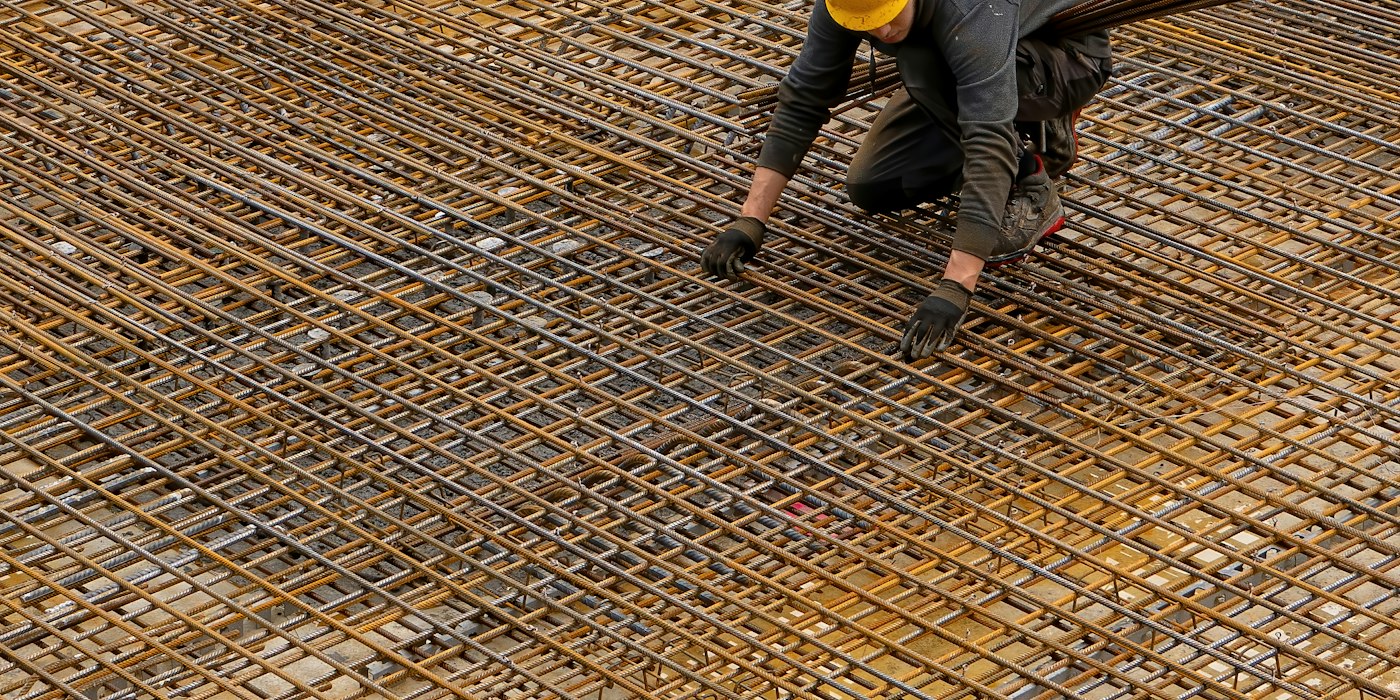
Reinforcing mesh does not change the volume enough to matter. It sits in the slab, usually on bar chairs to hold it in the lower-middle of the thickness, and the concrete fills around it. The same goes for conduit and pipes. Thickened edges, on the other hand, do matter: if the slab has a deeper perimeter beam, calculate that as a separate strip and add it on.
Work it out
The concrete slab calculator takes length, width and thickness in metres or feet and inches, adds a waste allowance and gives the volume, the weight and the bag count for common bag sizes. For footings and other shapes, the general concrete calculator covers slabs, strips and holes in one place, and the post hole concrete calculator handles fence and deck posts, subtracting the post itself. More building and garden calculators are in the DIY section.